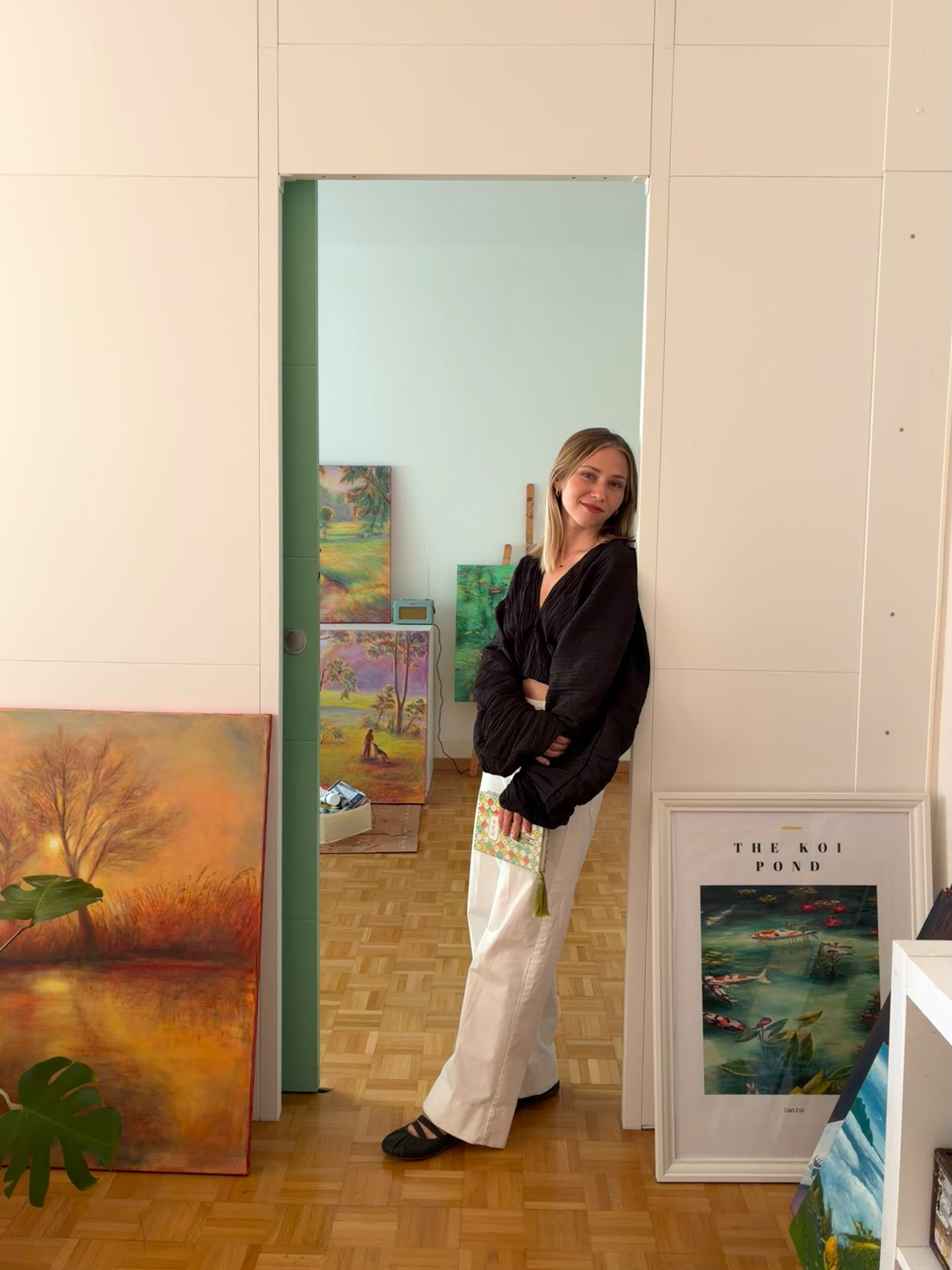
Before we begin, let's briefly introduce Tanya. Tanya is a young Ukrainian artist born in Kharkiv and living in Switzerland, whose work combines oil painting, acrylics and oil pastels. Her paintings move between observed reality and personal memory, creating intimate spaces inhabited by landscapes, portraits and fragments of lived experience. Recent exhibitions include her show at the Musée du Cheval in La Sarraz, where visitors were invited into a personal visual dialogue between present and past.
Tanya invites me to her place for a coffee. She starts positioning the coffee mugs on the little wooden table in the living room; a wooden Ukrainian coaster is also there, and there are some wafers – delicious chocolate wafers. She explains to me they also come from Ukraine and remind her of her childhood. And of course, we are surrounded by paintings, a lot of them.
This coffee is already turning into an artistic experience... And so it starts:
FP: "Tanya, let's start from the beginning. Who are you and why do you paint?"
TT: "I come from a little town next to Kharkiv in Ukraine, and since I was a kid, I have always been curious about new things. That's why I started studying linguistics, as I wanted to have access to different cultures and people. I wanted to explore the world and connect with different cultures, as I couldn't fully fit into the typical Ukrainian mindset, and in a way, literature was a tool for me to grow and develop my sensitivity. The idea of constantly outgrowing myself has always been part of my personal and professional development."
And as she speaks, in her room I see a beautiful sketch (a future painting perhaps?) where a little, grown-up girl is dominating the landscape... outgrowing, indeed. But no spoiler, please.
FP: "Were you already drawing and painting as a child, or did art come into your life later?"
TT: "When I was 10 years old, I joined an art school in Ukraine. This was the same art school that my father had also previously joined. My dad is a metal worker, but he studied and loved art, and he would give me some advice from time to time."
"It all started as a game: I was a kid and, at the beginning, I joined the school because I wanted to stay with a friend of mine. But it soon became clear that it was much more than a game: there were a lot of subjects to cover, the teaching was very academic, and it was not the easiest thing, studying there, especially because I was always the youngest."
FP: "Was there a particular moment or event that made you realize that painting would become an important part of your life?"
Tanya takes some time to reflect, then she starts.
TT: "When I was 14, as every teenager, I wanted to get some extra money to cover my expenses. The easiest option would have been working as a waitress, but my parents wouldn't agree to that. So I started doing commissioned work, mainly portraits; I would sell them for the equivalent of 1-2 CHF. It was the first time I looked at art as something more than a hobby." (...) "A few years later, when I was in Switzerland, the fact that I was an artist came back to my mind. At the beginning, I used art as 'art therapy' — it was a way for me to ground myself and deal with my anxiety about being elsewhere. But it soon became something more serious: I started applying for art teacher positions, and I eventually got my first job."
FP: "One thing that immediately strikes me about your work is your attention to places. I've seen beautiful paintings of Swiss landscapes and hidden corners, but also works depicting places further away, like Polignano a Mare in Italy. How has Switzerland influenced your artistic vision since you moved here?"
TT: "When I first came to Switzerland, I started observing and trying to feel connected to this Swiss landscape, which was so beautiful, almost unreal to me. I already knew the rules of how to paint because of my academic background, so I just started doing what I was good at: I started painting, and through painting I was reproducing what I observed around me."
She pauses.
TT: "Other than that, what Switzerland gave me was the chance to be at the centre of Europe and to travel to different places and attend many exhibitions. Because of this, I slowly started deconstructing my idea that a painting had to be a perfect representation of what you see — the need for a painting to be real. I started asking myself more questions; I wanted to dig deeper and express more, to learn more techniques. Art had always been meaningful to me, but now it was meaningful in a different way. I became even more curious."
FP: "One of your paintings that I really like is Presence, from 2024. There is something about its atmosphere that reminds me, very loosely, of Edward Hopper. At the same time, the treatment of the subject feels entirely your own. I also noticed that one of your works references Basquiat. Who are the artists that inspire you most?"
TT: "Something that influenced the way I think about art was Marina Abramović's book Walk Through Walls. Everyone knows her art, but her book really made an impression on me."
She takes her sketchbook and explains that she remembers better when she writes things down. Several names appear, from Gerhard Richter to Tyler Mitchell. Tanya likes photography, she explains — this is where most of the portraits come from. But what strikes me most is her little book, an artwork in itself, combining so many different inspirations: from texts and sketches to literature, poetry and paintings.
FP: "What fascinates me even more is how your work seems to move beyond observation and into memory. When I look at paintings such as Horizons or Childhood Reminiscence, I'm reminded of Marcel Proust's famous madeleine episode, where a simple sensory experience suddenly unlocks an entire world of memories. Does painting work that way for you?"
TT: "That's right. My recent paintings move away from simple things and aim at painting the feeling. They're really about thinking in colour. I just like colour. In Switzerland, I've seen a few exhibitions of the Fauvists and fell in love even more with that movement... I love how their colours are bold and messy but harmonious at the same time. Lately, the colours dominating my paintings have become more pastel — pink, purple and yellow. I started thinking that I don't want my art to be realistic if it can be dreamlike instead. I wanted to show the feeling rather than the place.
"This is how my art started going back to my childhood. As a kid, in summer, my parents would send me to stay at my grandmother's dacha (summer house), and I would have a lot of time to spend in the countryside — waking up early, surrounded by little streams of water and grass. I still feel nostalgic for those places. This is where Childhood Reminiscence comes from: it may look like just a tree (author's note: it does not!), but it's actually my childhood."
FP: "Another recurring theme in your work is portraiture. I'm thinking of works such as Sisterhood, Brittany, The Other... What draws you to painting people, especially women? Is there something in these subjects that resonates particularly strongly with your artistic language?"
TT: "I love meeting people who are authentic. I feel drawn to connect with them, and art is one way for me to do that. In Ukraine, as a teenager growing up, there are strict standards of beauty that a girl is expected to meet, and I could never fully identify with them. That's why, when I started meeting new people — first when I lived in Kyiv, and then when I moved abroad — I was always drawn to people who 'dared' to be different, to express their personality. And I painted them."
FP: "And just out of curiosity: would you enjoy painting male subjects as well, or do you feel naturally drawn toward female figures?"
Tanya laughs. She's never really thought about it — some of her paintings do feature men, Basquiat among them. Then she explains:
TT: "I would draw men too. I just feel more connected to the soul of women. That could be my next challenge."
FP: "I once read that your paintings invite us to look closely at another person. I find that a beautiful idea. And since some of your works are self-portraits, I have to ask: do you look at yourself with that same level of attention and curiosity?"
TT: "Self-portraits, for me, are either a way to get in touch with myself or a way to catch and preserve a moment of my life. It's a moment of self-reflection — I use self-portraits to deal with my emotions and reconnect with myself, and at the same time, as a way to preserve the memory of a specific moment. In principle, they're not even meant to be exhibited."
FP: "Let's talk a little about identity. In Sisterhood, for example, traditional Ukrainian embroidery appears in the clothing of the figures. How important is your Ukrainian heritage in your artistic practice today? I also remember seeing you at your exhibition in La Sarraz wearing a beautiful traditional necklace. Could you tell us more about its significance and what it represents for you?"
TT: "The necklace is called a sylianka — it's a traditional item that I like to wear. When I was younger, I wanted to discover new things, but now that I have, I still feel I want to stay in touch with my country of origin. Since the war started, I don't want to be silent about my identity. I also really appreciate the approach of the new generation: there are so many talented designers and stylists... I love how people show who they are through their clothes. I did that in Sisterhood, and I want to do it in my own life too. I love it when art becomes something functional — I used to paint on tote bags, and that's also what I teach my students."
She then shows me her painting called Pisnia, depicting a woman in traditional Ukrainian dress, playing a traditional Ukrainian instrument. Tanya explains that the instrument is called a bandura — a lute-like instrument with up to 65 strings, including up to eight melody strings and many accompanying strings.
I look at the painting. It's beautiful.
TT: "I think it's important to stay connected to one's traditions and roots,"
Tanya explains. Then she goes back to her sketchbook, where a beautiful sketch of blind performers playing the bandura appears. These were among the poorest people in society, she explains. Originally, the bandura was played by blind minstrels who travelled from village to village singing epic ballads and historical songs.
Their story caught her attention, and Tanya started sketching them.
FP: "Your artistic journey seems to have evolved from painting what you see to painting what you remember. That evolution feels connected to personal growth as much as to artistic development. Where do you think your work is heading next? Are there themes, techniques or questions you feel increasingly drawn to explore?"
TT: "I'd like to keep working with the colours I love, as well as with the relationship between people, nature and memory. I really like the theme of belonging and identity. Personally, I feel I don't fully belong anywhere — not to one place, at least. I belong to this circle of open-minded, free-spirited people: I've found my home here, but I believe I could find it anywhere else too. That's possible once you know your values and know who you are."
FP: "Let's finish with a question on Pro Swiss Art. What motivated you to join Pro Swiss Art?"
TT: "I like the Pro Swiss Art project because there's a lot of freedom — freedom to contribute. Everyone here is not just an artist but also an active contributor and decision-maker. The location is great too: really central and accessible."
FP: "That's really great. And what kind of support do you think young artists need most today?"
TT: "I'd like to help promote younger artists, because I see so many talented people around, and I think they should be able to make a living from their work. They shouldn't have to hide it — this isn't a hobby, it's an actual job."
As our conversation draws to a close, I find myself reflecting on the fil rouge that has run through our entire exchange: this idea of constantly growing, pushing beyond one's own limits, and remaining curious about the world. Tanya left Ukraine, discovered new cultures, explored different forms of artistic expression, and eventually found her way back to her roots.
Thank you, Tanya. You have definitely mastered the art of outgrowing yourself, and we can't wait to see what comes next.